
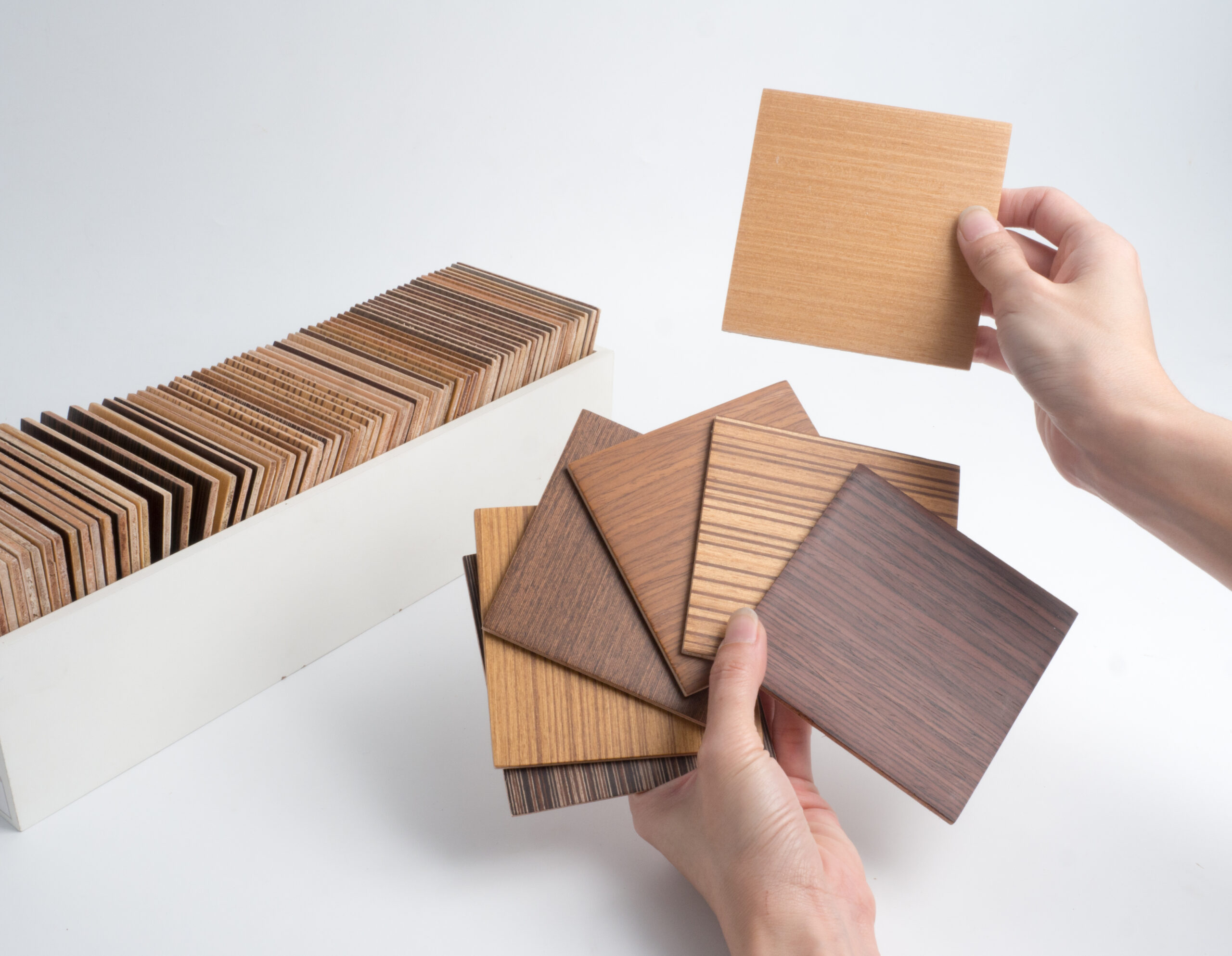
When many people hear the term “wood veneer,” they mistakenly assume it refers to a lower-quality alternative to solid wood. In reality, high-quality wood veneer is one of the most widely used materials in luxury cabinetry, architectural millwork, furniture manufacturing, and high-end interior design.
In many applications, veneer panels actually offer significant advantages over solid wood, combining the natural beauty of real wood with enhanced stability, design flexibility, sustainability, and long-term performance.
Engineered for Strength and Stability
Wood veneer is created by slicing thin sheets of real wood and bonding them to stable core materials such as plywood, MDF, or particleboard using high-performance adhesives and engineered manufacturing processes.
Unlike solid wood, which naturally expands and contracts with changes in humidity and temperature, veneered panels are designed to remain more dimensionally stable over time. The cross-laminated construction of many veneer panels helps reduce the risk of warping, cracking, twisting, and splitting that can occur with solid lumber.
This stability is especially important in large panel applications such as cabinetry, wall paneling, doors, furniture, and architectural millwork where maintaining clean lines and flat surfaces is critical.
Modern wood adhesives used in veneer manufacturing are also extremely durable and are designed to provide long-lasting performance in demanding environments.
A More Sustainable Use of Natural Resources
One of the biggest advantages of wood veneer is its efficient use of valuable wood species. Because veneer sheets are sliced very thinly from a log, manufacturers can produce significantly more usable surface area compared to traditional solid lumber production.
This process helps maximize material yield while reducing unnecessary waste, making veneer a more environmentally responsible option for many woodworking and architectural applications.
Veneer manufacturing also allows highly figured, rare, or decorative wood species to be used more efficiently while preserving the natural beauty and character of the original wood.
Exceptional Design Possibilities
Wood veneer offers design capabilities that are often difficult or impossible to achieve with solid wood alone. Through techniques such as book matching, slip matching, sequence matching, and blueprint matching, veneer panels can create dramatic visual patterns and continuous grain flows across large surfaces.
Architects and designers frequently use veneer to achieve clean, consistent, and highly sophisticated appearances in modern interiors.
Because veneer panels are more stable than large solid wood surfaces, they also perform better in environments exposed to fluctuating humidity and temperature conditions.
The Beauty of Real Wood
High-quality veneers are produced from carefully selected logs chosen for their grain, figure, and natural character. The result is a genuine wood surface that delivers the warmth, texture, and elegance of real hardwood while offering greater consistency and versatility.
From contemporary minimalist interiors to traditional architectural millwork, wood veneer provides a refined appearance that continues to make it one of the most popular materials in premium woodworking and interior design.
A Smart Solution for Modern Projects
Today’s wood veneer products combine beauty, performance, sustainability, and efficiency in ways that solid wood alone often cannot. For many residential, commercial, and architectural applications, veneer panels provide the ideal balance of aesthetics, durability, and practicality.
At Plywood Express, we offer a wide range of premium veneer panels, plywood, and architectural wood solutions for custom millwork, cabinetry, furniture, and interior design applications. Contact our team to learn more about our available veneer species, finishes, and panel solutions.