
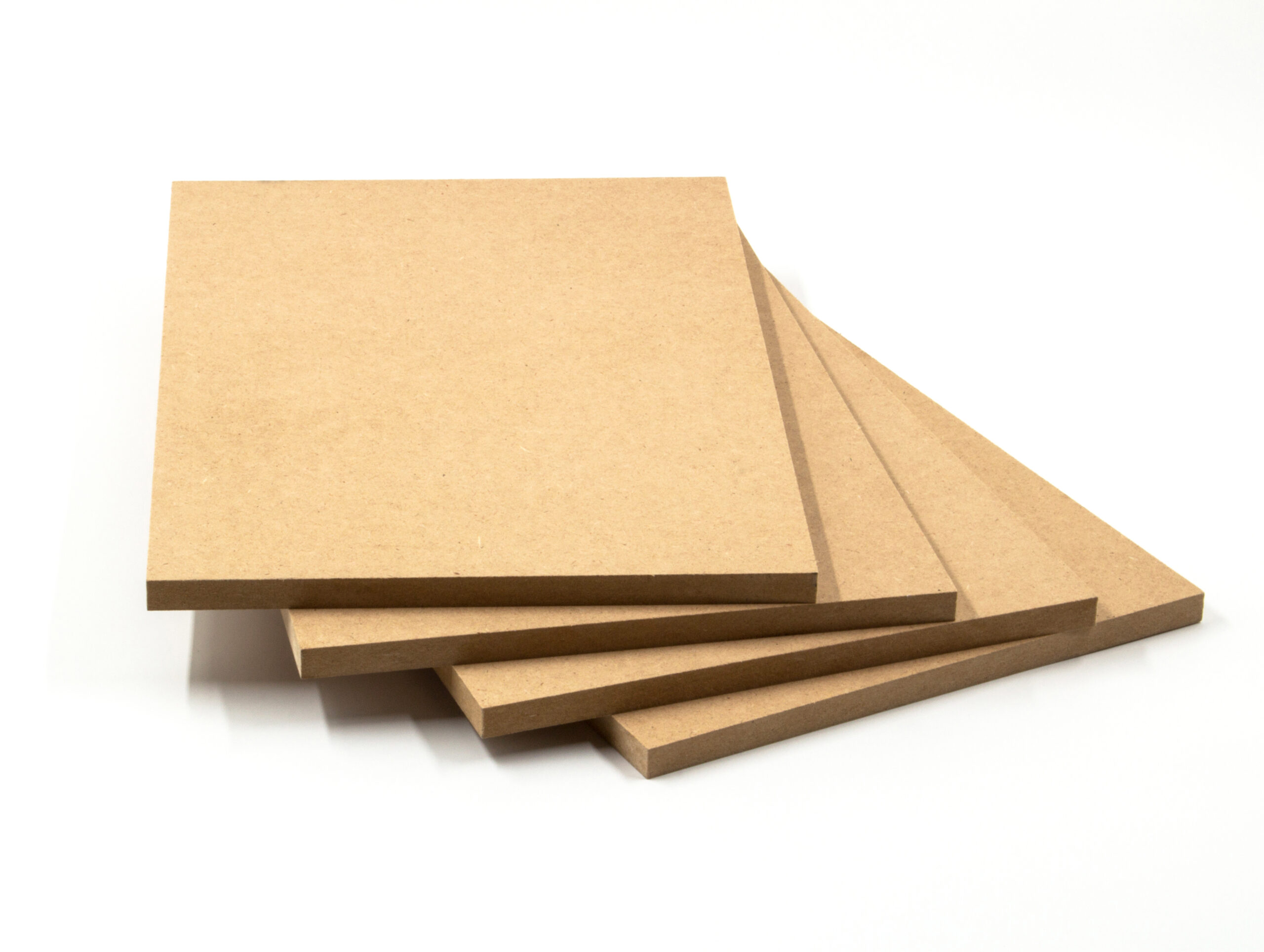
Medium Density Fiberboard (MDF) is one of the most versatile engineered wood products used in the woodworking, architectural, and interior design industries today. Manufactured from refined wood fibers bonded together under high pressure and high temperatures. MDF offers excellent consistency, smooth surfaces, and dimensional stability.
Because of its uniform composition and ease of machining, MDF is widely used in cabinetry, wall paneling, furniture manufacturing, millwork, and decorative applications.
What Makes MDF So Popular?
MDF is known for its smooth and flat surface, excellent machining capabilities, consistent core composition, durability, and versatility across multiple applications. Unlike natural wood, MDF does not contain knots or grain irregularities, allowing for cleaner cuts, superior finishing, and highly detailed fabrication.
Depending on the project requirements, several MDF variations are available to meet specific performance and design needs.
Regular MDF
Regular MDF is manufactured from refined wood fibers compressed into dense, stable panels. It is typically heavier and denser than plywood, offering excellent rigidity and machining performance.
Because of its smooth surface and dimensional consistency, regular MDF is commonly used for cabinet doors, shelving, decorative wall panels, furniture components, and interior millwork. Its stability and uniform density make it ideal for painted applications and precision CNC machining.
MDF Ultra Lite
Ultra Lite MDF offers many of the same benefits as standard MDF while significantly reducing panel weight and density.
The lighter composition makes the material easier to transport, handle, and install, especially in applications where structural performance is not the primary requirement.
Ultra Lite MDF is commonly used for decorative panels, ceiling features, non-structural millwork, display fixtures, and lightweight furniture components. It helps improve handling efficiency without sacrificing the smooth finish and workability associated with MDF products.
Colored MDF
Colored MDF combines the performance characteristics of traditional MDF with a solid color core throughout the panel.
Because the material is colored through the entire thickness, exposed edges maintain a consistent appearance without requiring edge banding or additional finishing.
Colored MDF is frequently used in retail displays, decorative furniture, architectural millwork, interior design accents, and modern cabinetry. It provides architects and designers with additional creative flexibility while maintaining the machining benefits of MDF.
Moisture Resistant MDF
Moisture Resistant MDF is specifically engineered for environments exposed to elevated humidity
levels.
These panels are designed to reduce swelling and improve dimensional stability in interior spaces where moisture may be present, such as
spaces where moisture may be present, such as bathrooms, kitchens, laundry rooms, commercial interiors, and hospitality applications.
Moisture resistant MDF is intended for interior use and should not be confused with fully exterior-rated panels.
No Added Formaldehyde (NAF)
No Added Formaldehyde MDF is manufactured with resins that contain no added formaldehyde, helping reduce indoor air emissions and support healthier interior environments.
Formaldehyde is a naturally occurring chemical compound used in many industrial products. NAF panels are designed to meet stricter environmental and indoor air quality standards.
These panels are commonly specified for educational facilities, healthcare environments, residential interiors, and sustainable building projects. NAF MDF can also contribute toward environmentally conscious building practices and certification requirements.
Fire Rated MDF
Fire Rated MDF is developed for applications where enhanced fire performance is required under building codes and regulations.
These panels are engineered to help slow flame spread and improve fire performance in interior applications.
Fire rated MDF is commonly used in commercial interiors, public buildings, wall panel systems, hospitality projects, and institutional environments. Depending on the product specification, fire rated MDF may meet Class A or other recognized fire performance standards.
Exterior Grade MDF
Exterior Grade MDF is engineered with increased density, moisture resistance, and durability compared to standard MDF products.
These panels are designed to withstand more demanding environments and provide improved resistance against moisture exposure, termites, fungus, and weather-related movement.
Exterior grade MDF is commonly used in protected exterior or high-moisture applications where enhanced panel performance is required.
Choosing the Right MDF for Your Project
Each MDF variation is designed to meet different performance, environmental, and design requirements. Selecting the appropriate panel depends on factors such as the application type, moisture exposure, fire performance requirements. weight considerations. sustainability goals, and the desired visual appearance.
From cabinetry and wall paneling to architectural millwork and commercial interiors, MDF continues to be one of the most adaptable and widely used engineered wood products in the industry today.